

C.O.R.N. Newsletter: 2023-33
-
Remembering Dr. Mark Sulc.

Dr. Mark Sulc, a long-time member and contributor to the Agronomic Crops Network, passed away on September 16, 2023, following a two-year battle with glioblastoma. Dr. Sulc retired from the Department of Horticulture and Crop Science last autumn, marking over thirty years as the Ohio State Forage Extension Specialist. His outreach activities expanded and disseminated knowledge on forage production and management systems for Ohio. Mark developed quality, in-depth training opportunities for Extension agents, industry professionals, and producers. Mark maintained an active research program throughout his career with a focus on forage crop management, especially in relation to disease and insect pests. He was an excellent collaborator and typically worked in multi-disciplinary groups involving partners at OSU and other universities, including collaborators in Brazil.
Mark remained active and productive throughout his career. It is noteworthy that he published seven refereed journal articles in his final three years of service. In addition, he was a significant contributor (co-PI) on a successfully funded USDA-AFRI project on, “Fall Armyworm Outreach and Research for Alfalfa Growers and Educators”, which has multiple years of funding remaining.

Dr. Sulc’s Contributions to the Agronomic Crops Team (by Lindsey)
Dr. Sulc was an active member of OSU Extension’s Agronomic Crops Team. He participated in weekly conference calls, providing forage updates and recommendations. Over his 30-year career, Mark authored 443 Extension newsletter articles, bulletins, and Fact Sheets. He gave 312 in-state presentations and 46 out-of-state presentations. Mark valued Extension outreach and worked purposely and meticulously to provide farmers and other stakeholders with quality information. Prior to his retirement in October 2022, Mark worked diligently to complete projects, including updates to the forage chapter of the Ohio Agronomy Guide. Mark was recognized nationally and internationally for his research on topics related to alfalfa quality, integrated crop-livestock systems, field evaluation of potato-leaf hopper resistance in alfalfa, and field evaluations of low-lignin varieties of alfalfa. His program will have a lasting impact on farmers not only in Ohio but across the globe through his international efforts.
Mark prioritized service to people above all else, which is reflected in his Extension program and mentorship. All of us on the AgCrops Team are extremely grateful to have known Mark as a colleague, mentor, and friend.
Dr. Sulc’s Mentorship (by Verhoff)
Dr. Sulc was incredibly active as a mentor and advisor to the graduate students he took on throughout his career. From the initial interaction, he treated his students as equals and partners in developing a research project that interested and excited everyone involved and had the greatest potential impact on the agricultural community. He was generous with his scholarship and his professional network, always discussing an interesting paper and introducing his students to his colleagues from across the country and internationally. Dr. Sulc led by example - in forage, and especially grazing research, there are a lot of repetitive measurements throughout the growing season and Dr. Sulc was in the truck and walking the pasture right alongside his students taking as precise measurements as possible. That precision transferred into the academic writing of his students as well. From a student’s perspective, there were always edits and suggestions on anything that was sent to Dr. Sulc, and the time and care he put into reviewing the slightest detail of the research project, helped build the professional skillset of every student he mentored.
Dr. Sulc’s commitment to his students and research was relentless. Even as his mobility became a growing obstacle, he still made it a priority to visit research plots and contribute to his student’s work in whatever capacity he was able. When he retired to spend more time with his family, he would still call and talk for an hour or two about the research, data analysis, and writing process of the current and concluding projects. At this point, it would be remiss to not thank his wife Sally for her help and support through Dr. Sulc’s retirement and all that came with it. Dr. Sulc’s commitment to his students epitomized what it means to be a mentor and his impact on the academic and agricultural communities will continue to grow. I cannot thank him enough for everything he has done, he is greatly missed.
Mark was born in Hagerstown, Maryland but grew up in Brazil where his parents were missionaries. Mark continued to minister to international students throughout his career. He earned his BS and MS degrees at Iowa State University and his Ph.D. from the University of Wisconsin. During his tenure at Ohio State, Dr. Sulc served as Interim Chair of the Department of Horticulture and Crop Science from 2011 to 2012. Mark is survived by his wife of 41 years, Sally, and four children (Jenna, Kelsey, Nathan, and Peter) and their actively growing families. Mark’s obituary may be found at: https://www.tiddfuneralservice.com/obituaries/reuben-sulc.
-
Battle for the Belt: Episode 29

Episode 29 of Battle for the Belt is now available: https://www.youtube.com/watch?v=MLexs5y9t3o
In episode 29, we talk with Dr. Elizabeth Hawkins, one of our Agronomic System Field Specialists with Ohio State Extension, about preparing combines for harvest. Elizabeth also manages the eFields program. The eFields program is an annual report of on-farm research conducted in the state. Look forward to the release of the 2023 eFields this upcoming winter and check out previous years’ reports here: https://digitalag.osu.edu/efields
Harvest Preparation Tips
- Get Ready Early: Get in your machine and check your components. Look for any parts that are worn and need to be replaced. This way everything is ready to go when the crop is ready to come off.
- Calibrate: Don’t forget to calibrate your combine! Calibration is necessary to retrieve quality yield data from your farm. Quality yield data can help you make informed management decisions for the next season like hybrid/variety selection, fertilizer management decisions, etc. Calibrating your combine will take extra time; however, the time is worth it to obtain accurate yield data.
- Keep an Eye on Conditions: As moisture and test weight change, the calibration may get a little off. Occasionally run a load and check that weight against the yield monitor to make sure that they are in alignment. If they are not the same, calibrate the combine again to ensure accurate weights are recorded.
Battle For the Belt Location Updates
The soybeans at the Wooster location are all at R6 (full seed) except for planting date 5. The earlier planting dates are starting to change color, but no pods are at harvest color yet. The corn at this location is drying down well with almost every planting date at R6 (maturity). We are waiting for planting date five to achieve the dented stage which is currently at R4 (dough, Figure 1). During disease rating, tar spot was found in planting dates four and five. The severity was not above 1%. If you farm in this area, take some time to see if you may have tar spot in your fields. Scouting for this now will help make management decisions in the future.

At the Western location, soybeans for planting dates one and two are at R7 (beginning maturity), having at least one pod on the plant at harvest color. The rest of the planting dates are at R6 (full seed) (Figure 2.). At Western, all corn is at maturity (R6). While disease rating planting date five, small amounts of tar spot were found. The tar spot at this location came in late and was at 1% or less severity.
None of the soybeans have reached R7 (beginning maturity) yet at the Northwest location, so every planting date is currently at R6 (full seed). Planting date five in corn is at R5 (dent) but the rest of the planting dates are at R6 (maturity).

Table 1. Planting dates one, two, three, four and five in the trial at all three locations with the day of planting, soil, air temperature averages, and Growing Degree Days (GDDS). Information from CFAES Weather System, https://weather.cfaes.osu.edu/.
 Keep following the ‘Battle for the Belt’ this growing season to learn more and get further updates! You can find the full video playlist of Battle for the Belt on the Ohio State Agronomy YouTube channel.
-
Weather Update: Dry Weather Has Returned

Summary
After a rather cool summer and some moisture recovery for many areas in Ohio in July and August, very dry weather has taken over in September. Temperatures have averaged close to normal through the first three weeks of the month (Figure 1 – left), though we have seen a few hot days and cold nights (low 40s last week in spots). Precipitation deficits are running anywhere from 1-4 inches below average, representing less than 25% of normal for much of the state (Figure 1). Several stations, including the Cincinnati, Columbus, Findlay, Cleveland, Akron, and Youngstown areas are experiencing one of their top five driest Septembers on record with less than a week until the end of the month. This has led to rapid crop drying, drying ponds, creeks, and streams, browning lawns, wilting of unirrigated landscape plants, and visible stress to young trees with some early color and leaf loss. As of Thursday, September 21, 2023, over half of the state was described as abnormally dry according to the U.S. Drought Monitor, with deteriorating conditions likely in the next couple of weeks. Though perhaps welcome for an efficient harvest, this dryness poses risks including the need for additional moisture to finish off crops, increased combine and field fires, and potential challenges for cover crop and wheat germination and stand establishment this fall. For more information, check out the State Climate Office and sign up for our monthly and quarterly climate summaries.

Forecast
After a light glance of moisture from Tropical Storm Ophelia over the weekend, attention has turned to a low pressure area moving into the Ohio Valley for Tuesday through Thursday this week. On and off again showers and isolated storms are possible through mid-week, with fair conditions returning for the weekend. Temperatures will remain a bit above average, with highs mainly in the 70s to low 80s this week. The current forecast shows anywhere from less than 1 inch of rain across northeast Ohio to as much as 1.50 inches in south central Ohio. However, the heaviest rainfall is likely to be scattered and isolated, with most areas seeing less than 1 inch of rain over the next 7 days (Figure 2).

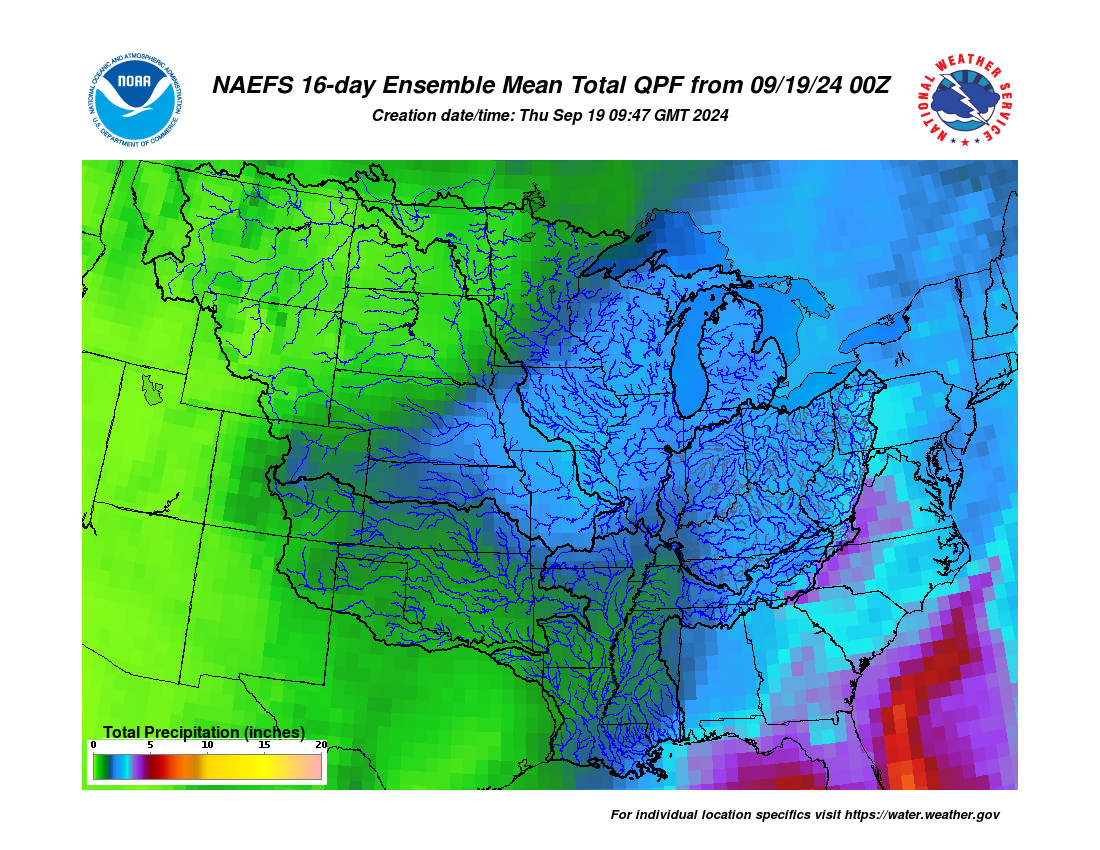
The Climate Prediction Center’s 8-14 Day Outlook and the 16-Day Rainfall Outlook from NOAA/NWS/Ohio River Forecast Center indicate that above average temperatures are likely for Ohio with precipitation leaning toward below average for the period of October 3 – 9, 2023 (Figure 3). For this time of year, the average high-temperature range is 71-75°F, the average low-temperature range is 50-53°F, and the average weekly total precipitation is about 0.70-0.80 inch.

-
Regional Updates: September 19 – 25

Farm Science Review is wrapped up and soybean harvest has just begun. Waterhemp escapes and volunteer corn continues to be reported in soybeans, though many fields are clean. Tar spot of corn is still progressing in fields, and now is the time to start scouting for ear molds. Keep reading below to find out what OSU Extension Educators and Specialists are observing in fields across the state.
Northeast Ohio
Andrew Holden of Ashtabula County reported on behalf of Agronomic Crops Team members representing Northeast Ohio that the majority of soybeans are approaching full maturity and are in good condition. Corn has reached the black layer and is in fair condition. Haymaking and corn silage are wrapping up, and early planted beans are beginning to be harvested followed by wheat planting.Central & West Central Ohio
Ryan McMichael of Mercer County reported on behalf of Agronomic Crops Team members representing Central & West Central Ohio that corn is between growth stages R5 (dent) and R6 (black layer) and soybean between R7 (beginning maturity) and R8 (full maturity). Both corn and soybean are in good condition, despite current dry conditions. Main field activities include tile installation, corn silage harvest, and early soybean harvest.Northwest Ohio
Clint Schroeder reported on behalf of Agronomic Crops Team members representing Northwest Ohio. April-planted corn is rapidly drying down and fields planted in mid-May are at or near physiological maturity or black layer. Early soybean yield reports are encouraging, ranging from 60 to 70 bu/ac at 12.5% to 14.5% moisture in parts of Northwest Ohio. Corn silage harvest and 4th cutting of dry hay continued this past week, and red clover that was frost-seeded into winter wheat is now being harvested for forage use.Southwest Ohio
Ken Ford reported on behalf of Agronomic Crops Team members representing Southwest Ohio. Soybeans are beginning to dry down over this past week. Very few pockets of harvest have been completed on some early-planted soybeans. With the continued dry and warm conditions harvest in the southwest will drastically ramp up this week, depending on what moisture we get from the scattered showers in the forecast. Corn is still a concern for some parts of the region as the Mid to Late May planted corn is still struggling to reach the black layer status. In particular, one farmer pulled out of chopping silage as the corn had not reached an acceptable maturity. April planted corn is maturing and drying rapidly and harvest of this corn will also begin to ramp up this week.

-
2023 End-of-season Corn Yield Forecasts

Most of the corn acreage in Ohio is now at dented (R5) and mature (R6) stages. On the September 18 USDA crop progress report (week Ending 09/17/23), dented corn progress was 67 percent complete, and mature corn progress was 22 percent complete. Despite row crop progress remaining slightly behind the five-year average, favorable crop condition ratings exceeded previous year averages.
The 2023 end-of-season corn yield forecast is now available for Ohio and the Corn Belt region. The forecast uses the UNL Hybrid-Maize crop model in collaboration with faculty and extension educators from 10 universities. Forecasts help researchers, growers, and industry stakeholders to make management, logistics, and marketing decisions during the crop season. Forecasts cover 40 locations across the Corn Belt, including South Charleston (Western Ohio), Custar (Northwest Ohio), and Wooster (Northeast Ohio). Table 1 and Figure 1 summarize the 2023 end-of-season corn yield forecast results.


Summary
Despite a rough year with development variability and dry periods, the 2023 end-of-season Corn Yield Forecast results for Ohio are promising:
- The chances of below-average yield potential are none for the Custar and South Charleston sites and an 8% chance of below-average yields for the Wooster site (Table 1).
- Projections show a 21% (Custar site), 45% (South Charleston site), and 66% (Wooster) probability of near-average yield potential (Table 1).
- The Custar and South Charleston sites show a 79% and 55% probability of having above-average yield potential. Wooster’s conditions are not as optimistic, with only a 26% chance of above-average yields (Table 1).
Regional projections show that most corn has reached maturity, and yield potential is variable. Aggregated across all sites, yield potential this season is about 7% below the historical average. Regional observations include:
- A little over half of the sites have a high probability of below-average yields, primarily located in the central, western, and northwestern Corn Belt (Figure 2).
- Most sites in the eastern part of the Corn Belt and a few in the central/western Corn Belt have a high probability of near-average yields (Figure 2).
- Above-average yields are expected at about half of the sites, primarily across the western and eastern Corn Belt (Figure 2).
These yield forecasts do not consider other yield-limiting factors such as crop stand issues, storm damage, replanting, disease, or nutrient losses. Likewise, results can deviate with varying planting dates or hybrid maturities. Yield forecasts are not field-specific and represent an average yield estimate for a given location and surrounding area.
As corn harvest season approaches in Ohio, we wish you well.
Reference
Grassini, P., Andrade, J., Rizzo, G., Yang, H., Rees, J., Coulter, J., Licht, M., Archontoulis, S., Ciampitti, I., Singh, M., & Ortez, O. (2023). Corn Yield Forecasts as of August 23. UNL Nebraska CropWatch. Available from: https://cropwatch.unl.edu/2023/2023-corn-yield-forecasts-end-season-forecasts-suggest-near-below-average-yields-region
-
Lep Monitoring Network Update #21 – Fall Armyworm Update
Introduction
The Ohio Lep Network is in our 21st week of monitoring for agronomic pests across Ohio. This week we will continue to provide an update on fall armyworm (FAW). For more information on these pests and many more, check out our website: https://aginsects.osu.edu
Fall Armyworm
We are in our fifth week of monitoring for the fall armyworm (FAW) in Ohio. Overall, 18 counties monitored 51 traps across the state. Like last week, numbers remain low across the state, except for Hardin and Henry counties, which recorded averages over 7 (Figure 1). To learn more about the fall armyworm moth, click here: https://aginsects.osu.edu/news/fall-armyworm-monitoring-begin

Crop Observation and Recommendation Network
C.O.R.N. Newsletter is a summary of crop observations, related information, and appropriate recommendations for Ohio crop producers and industry. C.O.R.N. Newsletter is produced by the Ohio State University Extension Agronomy Team, state specialists at The Ohio State University and the Ohio Agricultural Research and Development Center (OARDC). C.O.R.N. Newsletter questions are directed to Extension and OARDC state specialists and associates at Ohio State.
Contributors
Disclaimer
The information presented here, along with any trade names used, is supplied with the understanding that no discrimination is intended and no endorsement is made by Ohio State University Extension is implied. Although every attempt is made to produce information that is complete, timely, and accurate, the pesticide user bears responsibility of consulting the pesticide label and adhering to those directions.
CFAES provides research and related educational programs to clientele on a nondiscriminatory basis. For an accessible format of this publication, visit cfaes.osu.edu/accessibility.